

Figuring out how high a TV should be above a media console is less about finding one universal number and more about getting the screen to a comfortable viewing height. Your seated eye level, the TV's actual dimensions, and the height of the console all affect where the TV should go.
Start with your seated eye level, use the TV's height to find the proper screen center, and then check the gap between the TV and console. From there, small adjustments can account for viewing distance, seating style, soundbars, and the layout of the room. A quick cardboard test before drilling can also save you from unnecessary wall repairs later.
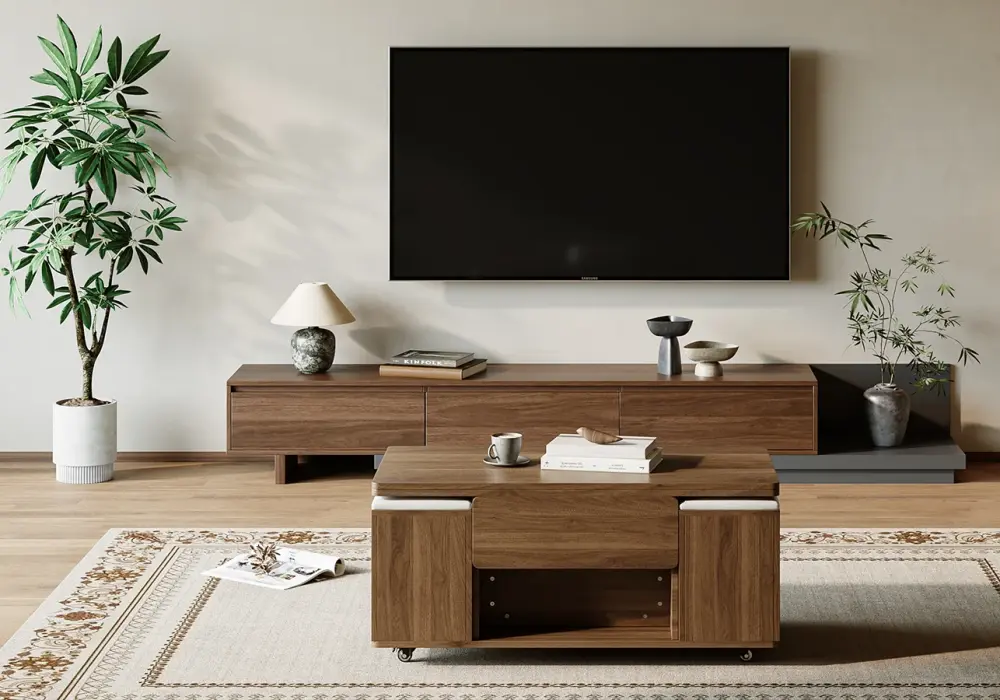
Fero 79"-142" Extendable TV Stand
Table of Contents
The TV Mounting Height Formula: Center the Screen at Seated Eye Level
The most useful starting point for TV mounting height is the center of the screen. Ideally, that point should sit close to your natural seated eye level rather than being determined by the amount of wall space above the media console.
For many seating setups, eye level falls around 42–48 inches (107–122 cm) from the floor. Your actual measurement may be different. A low sofa, deep cushions, or a more upright chair can all change where your eyes sit.
How to calculate the TV bottom height
Use four measurements:
1.Measure your seated eye height. Sit where you normally watch TV and measure from the floor to your eyes. Use your usual posture rather than sitting unusually straight or slouching.
2.Measure the TV itself. TV sizes are given by diagonal screen measurement, not height. A standard 16:9 55-inch TV is about 27 inches (69 cm) tall, but the exact dimensions vary by model and bezel size. Check the manufacturer's specifications before installing the mount.
3.Divide the TV height by two. That gives you the distance from the bottom of the TV to the center of the screen.
4.Subtract that number from your seated eye height. The result is the approximate height of the TV's bottom edge above the floor.
The formula
TV bottom height = seated eye height − (TV height ÷ 2)
Here is a simple example. Say your seated eye level is 42 inches (107 cm) and your 55-inch TV is approximately 27 inches (69 cm) tall:
42 − (27 ÷ 2) = 28.5 inches
That puts the bottom of the TV at about 28–29 inches (71–74 cm) from the floor.
From there, compare that measurement with your media console. A 24-inch-high console would leave roughly a 4–5 inch gap. A 30-inch console would put the console top above the calculated TV bottom, so creating a larger gap would require raising the TV and, with it, the center of the screen.
This is where two measurements often get mixed up:
- Floor to TV center determines viewing height.
- Console top to TV bottom determines the gap between the furniture and the screen.
They are not interchangeable. Mounting the TV based only on the space above the console is a common way to end up with a screen that sits higher than it should.
If your console is too tall for the calculated position, lowering the furniture is often more useful than raising the TV. A smaller gap is easier to work with than a screen that forces you to look noticeably upward.
TV-to-Console Gap Chart: How Much Space to Leave Above the Media Console
Once you've worked out the TV's target position, you can figure out how much space should remain between the screen and the console.
For many setups, 4–8 inches (10–20 cm) is a comfortable place to start. A larger 8–12 inch (20–30 cm) gap may be necessary when you need room for a soundbar, cable connections, an infrared receiver, or ventilation around components.
The table below shows how different TV and console combinations affect that gap, using a 42-inch (107 cm) seated eye height. The exact result will change with your seating position and the actual dimensions of your TV.
TV Size | Approx. TV Height | 20 in Console | 24 in Console | 28 in Console | 32 in Console |
50 in | 24.5 in / 62 cm | 9.7 in / 25 cm | 5.7 in / 14 cm | 1.7 in / 4 cm | -2.3 in / -6 cm — TV would be too high |
55 in | 27.0 in / 69 cm | 8.5 in / 22 cm | 4.5 in / 11 cm | 0.5 in / 1 cm | -3.5 in / -9 cm — TV would be too high |
65 in | 31.9 in / 81 cm | 6.1 in / 15 cm | 2.1 in / 5 cm | -1.9 in / -5 cm — TV would be too high | -5.9 in / -15 cm — TV would be too high |
75 in | 36.8 in / 93 cm | 3.6 in / 9 cm | -0.4 in / -1 cm — TV would be too high | -4.4 in / -11 cm — TV would be too high | -8.4 in / -21 cm — TV would be too high |
85 in | 41.7 in / 106 cm | 1.2 in / 3 cm | -2.8 in / -7 cm — TV would be too high | -6.8 in / -17 cm — TV would be too high | -10.8 in / -27 cm — TV would be too high |
A negative number means the calculated bottom edge of the TV would sit below the top of the console. In other words, keeping the TV at that viewing height would leave no conventional gap. Raising the screen to create one would also raise the screen center.
That becomes especially noticeable with 75-inch and 85-inch TVs. A larger display extends farther below its center, so a tall media console can quickly push the entire TV upward.
The furniture's width matters visually, too. A media console that is at least as wide as the TV, or slightly wider, often gives the arrangement a more balanced look. A TV that extends well beyond the sides of a narrow console can make the wall feel top-heavy. Still, don't choose a taller cabinet just to improve those proportions. A wider, lower console is often a better solution.
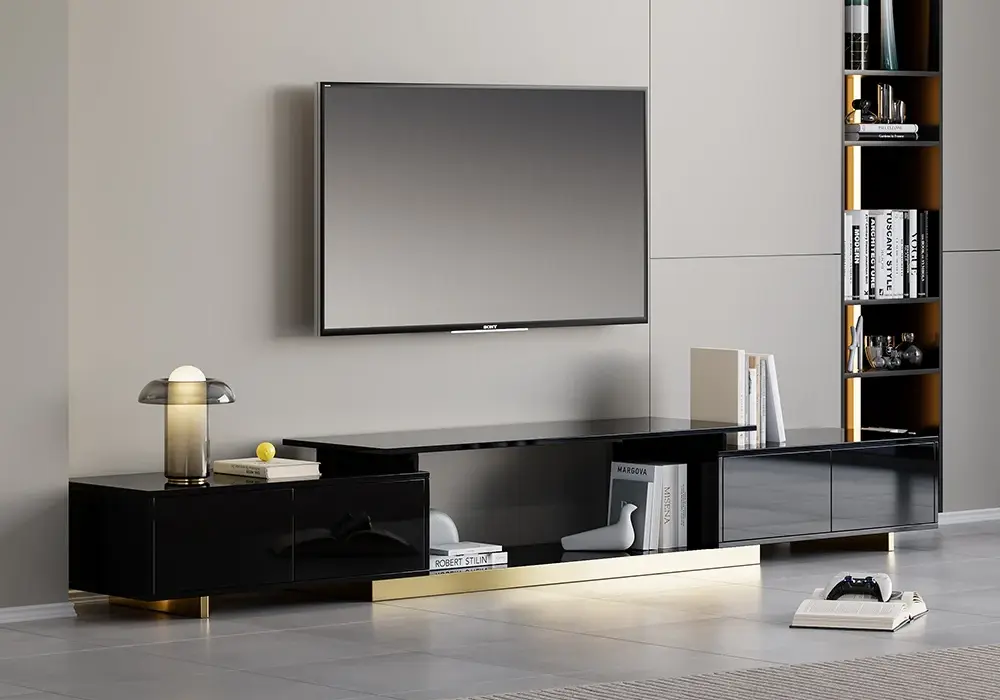
Mordel 63"-94" Extendable Black TV Stand
Adjust for Screen Size, Viewing Distance, and Seating Type
TV size changes the geometry of the installation, but the viewing distance changes how noticeable that height feels.
A 75-inch TV or larger deserves extra attention because its overall height makes it easier to place the screen center too far above eye level. When a large screen and a tall console compete for space, preserving a comfortable center height is more useful than maintaining a generous decorative gap.
Viewing distance matters in the opposite direction. In a small apartment, den, or compact open-plan living room, you may sit fairly close to the screen. A TV that is only a few inches higher can feel noticeably different at a short viewing distance than it would from farther across the room.
Consider a 65-inch TV viewed from about 8–9 feet (2.4–2.7 m). The screen center should stay close to the viewer's natural sightline. Raising it simply to create more open wall space can make the viewing angle feel less comfortable.
Your seating position also changes the calculation slightly. A recliner or deep sofa places the viewer farther back and at a more relaxed angle, so a TV can sometimes sit 1–2 inches (2–5 cm) higher than it would for upright seating. That is a small adjustment, not a reason to mount the screen at bar height.
A good installation starts with how the TV is actually watched. Furniture layout comes after that.
Avoid Mounting Too High — Common Mistakes and a No-Drill Way to Test First
Many TV-mounting mistakes come from treating the gap above the console as the starting point.
Mistake 1: Choosing the TV height from the console gap alone
Deciding on a fixed 6- or 8-inch gap sounds simple, but the same gap produces very different results with different furniture and screen sizes.
A 6-inch gap above a low console may place the screen at a comfortable height. The same 6 inches above a tall cabinet may push the TV center too far upward.
Fix: calculate the TV position from seated eye level first, then see how much space remains above the console.
Mistake 2: Copying a single height from the internet
Numbers such as “52 inches from the floor” are easy to remember and easy to share, but they leave out the dimensions that actually shape the installation.
A 50-inch TV and an 85-inch TV will not put their centers at the same height when their bottom edges are mounted at the same point.
Fix: measure your seating position and the actual height of your TV instead of relying on one universal number.
Mistake 3: Making the wall look symmetrical at the expense of viewing comfort
It is easy to focus on the visual relationship between the TV, media console, shelves, and other wall decor. A perfectly balanced composition is not much use if you have to tilt your head upward every time you watch something.
Fix: keep the screen center near your natural sightline, then adjust the surrounding furniture and decor around it.
Mistake 4: Assuming a tilting mount solves an overly high installation
A tilt mount changes the screen angle, not its height. Tilting the TV downward can improve the viewing angle when the installation is somewhat higher than normal, but it does not erase the extra elevation.
Fix: set the screen height correctly first and use a tilt feature as a secondary adjustment.
Test the height before drilling
A full-size cardboard or paper template is one of the easiest ways to check your measurements.
Cut the outline to match the TV's dimensions and mark the planned bottom edge on the wall with removable tape. Place the template at that height, sit in your normal viewing spot, and look at the screen the way you would during an ordinary evening.
Check the center of the screen, not just the top or bottom edge. Try more than one seating position if the room has multiple viewing spots. Pay attention to whether you naturally keep your head level or find yourself looking upward.
It is much easier to move a paper template than to relocate a wall mount and patch the holes behind it.
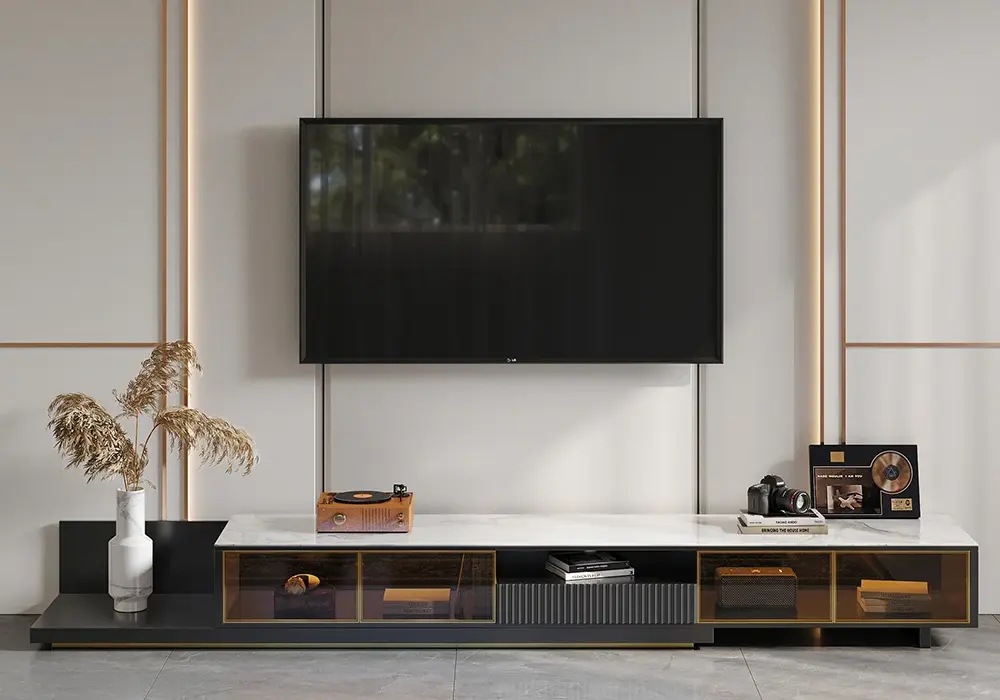
Special Cases: Fireplace Mantels, Floating Consoles, and Bedrooms
Some room layouts leave less flexibility than a standard TV-and-console arrangement. Fireplaces, floating furniture, and beds all change how the installation needs to be approached.
TV above a fireplace or mantel
A TV above a fireplace or mantel often ends up higher than a TV mounted above a low media console. The height of the mantel, chimney depth, available wall space, and heat exposure all come into play.
Before installing the TV in this location, check the TV manufacturer's requirements for operating temperature and installation clearances. The fireplace itself may also have specific clearance or installation requirements.
When the resulting screen height is well above your natural sightline, consider another wall, a lower furniture arrangement, or a pull-down TV mount that lets the screen come closer to eye level when you are watching.
TV above a floating media console
A floating console gives you more control over furniture height because it can be mounted lower on the wall than a floor-standing cabinet.
That makes it easier to keep the TV in a comfortable position while maintaining a 6–10 inch (15–25 cm) visual gap. Leave enough room behind or below the equipment for cables, power connections, and ventilation.
The console's wall-mounting system also needs to match the load and the wall construction. Check the manufacturer's installation instructions before mounting the cabinet.
TV in a bedroom
Bedroom TVs are commonly viewed from a more reclined position, so they can sit somewhat higher than TVs intended for upright seating.
A tilting mount is especially useful here because it lets you angle the screen toward the bed rather than pointing it straight across the room. Even so, the TV should not be so high that you have to lift your head to keep the screen in view.
Measure from your actual viewing position on the bed and make a mock-up before drilling. The correct height for a bedroom depends more on the viewing posture than on a fixed distance from the floor.
TV Height Measurement Checklist: Check These Before You Drill
Before installing the mount, write down these measurements:
Measurement | What to Record |
Seated eye height | Floor to your eyes while sitting normally |
TV actual height | Top to bottom of the TV |
Media console height | Floor to the top of the console |
Target TV bottom height | Eye height − half of TV height |
Console-to-TV gap | TV bottom minus console top |
Viewing distance | Seating position to screen |
Mount type | Fixed, tilting, full-motion, or specialty mount |
A TV height calculator can handle the math quickly, but the same measurements are still useful when you're comparing media consoles or TV mounts.
Five minutes with a tape measure and a cardboard template can save you from moving the mount later, patching unnecessary holes, or living with a screen that sits higher than you intended.
FAQ: TV Mounting Height Above a Media Console
What is the ideal height to mount a TV above a media console?
There is no universal height that works for every room. The center of the TV should be close to your seated eye level, which often falls around 42–48 inches (107–122 cm) from the floor depending on the seating setup. After that, check the space between the TV and the console.
How many inches (or cm) should be between the TV and the top of the console?
A 4–8 inch (10–20 cm) gap works as a starting range for many setups. You may need 8–12 inches (20–30 cm) for a soundbar, cables, an infrared receiver, or equipment ventilation. A smaller gap is preferable when a larger one would force the TV higher.
Should the TV center or the TV bottom determine the mounting height?
The TV center should determine the primary mounting height because it relates directly to viewing position. The bottom edge and console height are then used to work out the remaining gap.
How does TV size change the recommended mounting height?
Larger TVs extend farther above and below the center of the screen. With 75-inch and 85-inch TVs, a tall media console can leave little room for a normal gap without raising the TV too much. A lower console or smaller gap may be necessary.
What's the most common mistake people make when mounting a TV too high?
A common mistake is choosing the TV height solely from the distance above the media console. A neat-looking gap does not guarantee that the screen will sit at a comfortable viewing height.
How high should a TV be in a bedroom compared with a living room?
A bedroom TV can sit somewhat higher because viewers are generally more reclined. A tilting mount can help direct the screen toward the bed. Measure from the actual viewing position rather than using a standard floor height.
Can I mount a TV above a fireplace or mantel without making it too high?
You can, but the available space often places the TV higher than a standard console setup. Check the TV and fireplace manufacturer's requirements for temperature and clearance. When the screen would sit too high, a different wall or a pull-down mount can provide a lower viewing position.