

Patio furniture is bought for how it looks, but it is judged by how it holds up after a rainy season, a scorching summer, or one windy night. Most buyers choose on style, then find the set is too big for the space, too hot to sit on, or faded within a year.
Whether you call it patio, garden, or outdoor furniture, the same five decisions separate a set you enjoy for a decade from one you replace in three. This guide walks through them in order: how you'll use the space, how to measure it, which material suits your climate, what makes a set comfortable, and how to judge price by long-term value.
Table of Contents
Step 1: Decide How You'll Use Your Patio
Start with what you will actually do outside, not with a style. Your use decides the seat count, table height, comfort level, and how easy the furniture needs to be to move.
The main types of outdoor furniture:
- Dining sets: a table and upright chairs for regular meals.
- Lounge or sofa sets: low, deep seating around a coffee table, for relaxing and conversation.
- Bistro sets: a small table with two chairs, made for balconies and tight corners.
- Bar sets: tall tables and stools for casual entertaining.
- Benches: flexible extra seating along a wall or garden path.
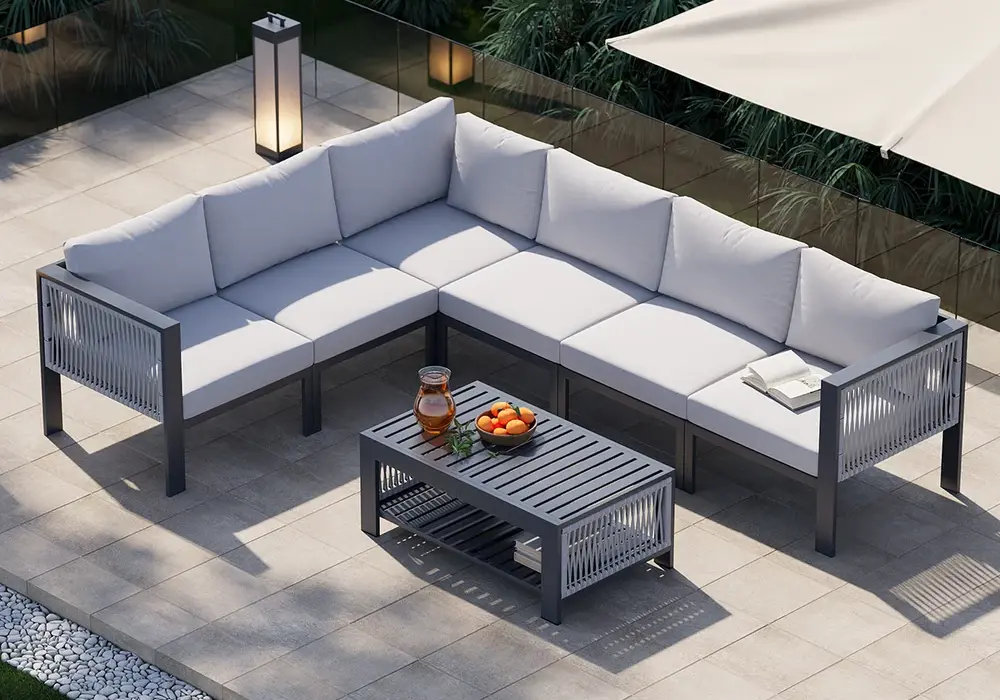
Two typical evenings show the difference. On a Friday night with friends, people sit low and stay for hours, so you want deep seating and a coffee table within reach. A modular set like the Fencura 7-piece sectional suits that scene: it seats up to six around a matching coffee table.
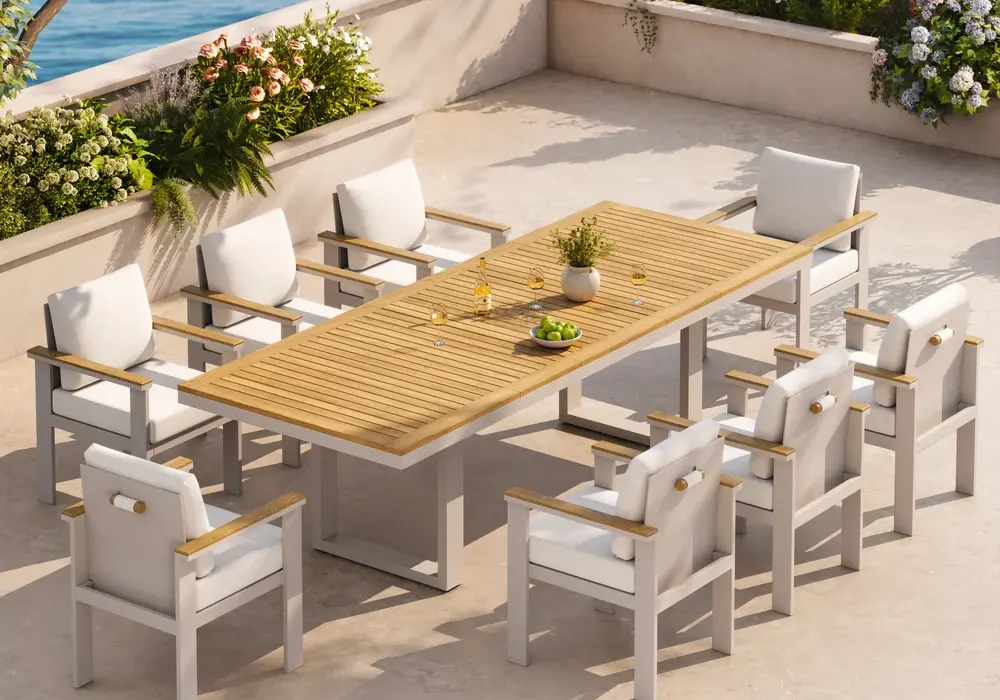
On a Sunday with the whole family, eight people need to eat at once, so you want an upright table that can stretch. The Tevara 9-piece extendable dining set suits that one: it seats eight, and its table has a central hole for a parasol.
Before you shop, answer this checklist:
- How many people will use the space daily, and how many when you host?
- Is it mainly for dining, lounging, or both?
- Do you need shade, and is any already there?
- Will children or pets use it?
- Will older family members or anyone who needs easy access use it?
Choose a dining-type or lounge-type set before you look at styles.
Step 2: Measure Your Patio and Plan the Layout
Measure before you buy, because the most common regret is a set that doesn't fit. Record:
- The patio's length and width
- Door, gate, and stair widths for delivery (and lift sizes if you live in an apartment)
- Where the grill or fire area sits
Then mock it up. Mark the furniture footprint on the floor with painter's tape or flattened cardboard boxes, and walk around it.
Clearance rules to plan around:
- About 90 cm (36 in) behind dining chairs, so people can sit down and stand up
- 90-120 cm (36-48 in) for main walkways
For a small patio or balcony, choose folding chairs, a round table, nesting side tables, or stackable seating. A few light pieces work better than a full set squeezed in.
Also keep clear of sliding doors, drains, and air-conditioning units, and leave the manufacturer's recommended safety distance around any grill or fire feature.
If it doesn't fit your tape outline, it won't fit your patio.
Step 3: Choose the Right Material for Your Climate
Material decides how long your furniture lasts and how much work it needs. There is no single best material, so choose for your conditions first and your looks second. Lifespans below are rough ranges with normal care.
Material | Pros | Cons | Best climate | Maintenance | Weight | Typical lifespan |
Aluminum | Rust-proof, light, many styles | Can blow over; can feel hot in sun | Coastal, humid, most climates | Low: wipe clean | Light | 10-15+ years |
Steel | Sturdy, stable in wind | Rusts if coating is chipped | Dry, windy sites | Medium: touch up chips | Heavy | 5-10 years |
Wrought iron | Very stable, classic look | Heavy; rusts without care | Dry, windy sites | Medium-high: repaint | Very heavy | 10-15+ years |
Teak | Naturally weather-resistant, premium look | Costly; silvers unless oiled | Most climates, including humid | Low-medium: oil or let it age | Medium | 20+ years |
Acacia / eucalyptus | Affordable hardwood look | Needs sealing; can crack in sun | Mild, temperate | Medium-high: seal yearly | Medium | 5-10 years |
HDPE recycled plastic | Rot-, rust- and salt-proof | Heavy; limited styles | Coastal, wet, any | Very low: wash | Heavy | 15-20+ years |
Resin wicker | Soft look, affordable | Can fade or crack in strong sun | Mild; shaded patios | Low-medium: clean, cover | Light | 5-10 years |
Glass and concrete tabletops are popular too. Glass is easy to clean but heavy and breakable, and concrete is very durable but too heavy to move.
Match the material to your climate
- Coastal or humid: choose rust- and salt-resistant materials such as aluminum, HDPE, or teak.
- Hot and sunny: look for UV-resistant finishes and lighter colors, and avoid dark metal surfaces that burn skin.
- Cold or freeze-thaw: plan to cover or store furniture in winter, and avoid materials that absorb water.
- Windy: heavier steel or iron stays put, while lightweight aluminum needs to be secured or stored.
Step 4: Check Comfort, Cushions, and Safety
Weatherproof furniture still has to be comfortable enough to use. Check these dimensions: seat depth and height, armrest height, backrest angle, and whether chair height suits the table.
If you can test in a store, do it properly:
- Sit for 5-10 minutes, not 30 seconds.
- Stand up from the seat to see how easy it is.
- Check that the armrests feel natural.
- Push dining chairs under the table to confirm they fit.
Cushion quality is where cheaper sets cut corners:
- Quick-dry foam drains water instead of holding it, which limits mildew.
- Solution-dyed acrylic keeps its color in strong sun far better than standard polyester, because the dye runs through the fiber.
- Water-resistant vs. breathable: a fully waterproof cover can trap heat and moisture, while a breathable fabric dries faster but needs covering in heavy rain.
- Removable, washable covers and replaceable cushions extend the life of the set.
For families, look for rounded corners, stable bases that don't tip, and darker or patterned fabrics that hide stains. Choose sturdy armchairs with moderate seat height for older users. If you have pets, pick scratch-resistant, easy-to-wipe surfaces.
A set you want to sit in will be used far more than one that only looks good.
Step 5: Set a Budget and Judge Long-Term Value
Style comes last. Match your home's exterior, flooring, and garden, whether modern, coastal, traditional, or boho, but never at the expense of size or weather resistance.
Judge by cost per year. Divide the total price by the years you expect the set to last. As an illustration, a US$400 set replaced every 3 years costs about US$133 a year, while a US$1,300 set that lasts 10 years costs about US$130 a year. Use the manufacturer's warranty and material lifespans, not guesses, for your own numbers.
Timing. Look for end-of-season sales, usually late summer to early autumn in the Northern Hemisphere and the reverse in the Southern, plus holiday promotions in your region.
Where to buy. Compare retailers on local stock, delivery and assembly, return policy, customer photos, replacement parts, and warranty. Confirm the seller ships to your country before you fall for a set.
Warranty. Check what it covers (frame, finish, cushions), how long it lasts, and what voids it.
Avoid these common mistakes:
- Not measuring the space
- Ignoring wind
- Skipping the warranty
- Buying cushions you can't replace
- Underestimating assembly time and effort
- Having no winter storage plan
Take Your Checklist Shopping
Before you order, save your patio measurements, photograph the space, and shortlist two or three sets. Then confirm delivery, assembly, and replacement parts with the seller.
FAQ
What is the most durable patio furniture material?
It depends on climate. Aluminum, HDPE, and teak resist rust and rot well in coastal or humid areas, while steel and iron suit dry, windy sites.
Which materials are the lowest maintenance?
HDPE recycled plastic and aluminum need little more than washing. Teak is low-maintenance if you accept its silvery aging.
What are the main types of patio and garden furniture?
Dining sets, lounge or sofa sets, bistro sets, bar sets, and benches. Choose by how you'll use the space.
How much clearance should I leave around patio furniture?
About 90 cm (36 in) behind dining chairs and 90-120 cm (36-48 in) for main walkways.
What is the best time of year to buy patio furniture?
Usually late summer to early autumn, when retailers clear seasonal stock. In the Southern Hemisphere, the timing is reversed.
What should I check in a patio furniture warranty?
What it covers (frame, finish, cushions), how long it lasts, what voids it, and whether replacement parts are available.