

The most common coffee table measurements are 16–18 inches high, 36–48 inches long, and 18–24 inches deep for rectangular designs. Each number has a job: height matches your sofa seat, length matches your sofa width, and depth matches the open floor in front of it. When browsing coffee tables, those three checks tell you quickly which dimensions work in your room.
This guide shows you how to read a standard table's dimensions, gives you a quick sofa-width chart to find your ideal length, and walks through three real examples (a lift-top, a round table, and a cloud-shaped table) with the setups where each one works best. For round, irregular, and lift-top designs, the key is reading the right number from the specification sheet: diameter for a round table, the widest envelope for a cloud shape, and both closed and raised dimensions for a lift-top.
Table of Contents
How to read the dimensions of a standard coffee table
A standard rectangular coffee table is described by three numbers, and each one answers a different question:
- Height (16–18 inches): relates to your sofa seat. Aim for a top level with the seat or slightly below it, so a cup is easy to reach and set down.
- Length (36–48 inches): relates to your sofa width. This is the number that decides how the table looks next to the sofa.
- Depth (18–24 inches): relates to the gap in front of the sofa. A deeper top gives more surface; a shallower one keeps more walking room.
A typical standard table might be listed as 44 × 22 × 17 inches. Read it as length × depth × height, then test each number against your room: 44 inches suits an 84-inch sofa (about 52% of its width), 22 inches of depth leaves a generous walkway behind it, and 17 inches sits comfortably beside most seat heights.
Dimensions in listing titles are often rounded or shortened, so open the full specification and confirm which dimension the headline number represents: length, diameter, maximum extension, or one piece of a set. Record everything in the same units to compare options accurately.
Start with four measurements from your room
Measure the sofa's main seating run, the height of its front seat edge, the open gap in front of it, and any route that crosses the seating area. Include furniture already in place; a television cabinet projecting from the opposite wall shortens the gap even if it looks visually light.
A coffee table of one-half to two-thirds of the sofa's main width gives balanced proportions. An 84-inch sofa, for example, pairs well with lengths from about 42 to 56 inches. Choose the longer end when the room has the depth to support it.
For a sectional, measure the seating area the table will serve rather than the whole outside perimeter. A chaise narrows the central opening, so a medium-length table paired with a side surface near the far seat often works best.
Quick guide: choose table length by sofa width
Find your sofa's width, then shop within the matching length range.
Sofa width | Recommended table length (½–⅔ of sofa) | Typical depth | Good fit |
72 in | 36–48 in | 18–22 in | Standard rectangular tables |
78 in | 39–52 in | 20–24 in | Standard rectangular tables |
84 in | 42–56 in | 20–24 in | The 47-inch lift-top, the 51-inch cloud table |
90 in | 45–60 in | 22–26 in | The 47-inch lift-top, the 51-inch cloud table |
96 in | 48–64 in | 22–28 in | The 51-inch cloud table; longer rectangles |
Sectional (main run) | Measure the run the table faces, then use ½–⅔ | 22–28 in | Rectangles, or round tables near the corner |
For every row, leave about 14–18 inches between the sofa and the table edge, and keep 30–36 inches or more along the main walking route.
Choose height in relation to the seat
A tabletop level with the sofa seat, or slightly lower, is convenient for drinks and everyday objects. Compare actual numbers: a 14-inch table beside an 18-inch seat sits 4 inches below it, which suits a relaxed lounge feel, while an 18-inch table beside the same sofa puts everything at hand level.
Seat cushions compress, so judge reach from a realistic seated position. Set a stable temporary surface at the proposed height and reach toward it naturally. You should be able to set down a cup without leaning far forward. For laptop or meal use, a higher surface (like a raised lift-top) works better than a low table.
Check the underside as well: a thick top or deep apron changes foot and knee space even when two tables share the same overall height.
Lift-top: best for work, meals, and hidden storage
The Grovyn 47-inch Fluted Lift-Top Hidden Storage Coffee Table is listed at 47 inches wide, 24 inches deep, and 17 inches high when closed, rising to 24 inches with the top raised. It also has two drawers and internal storage.
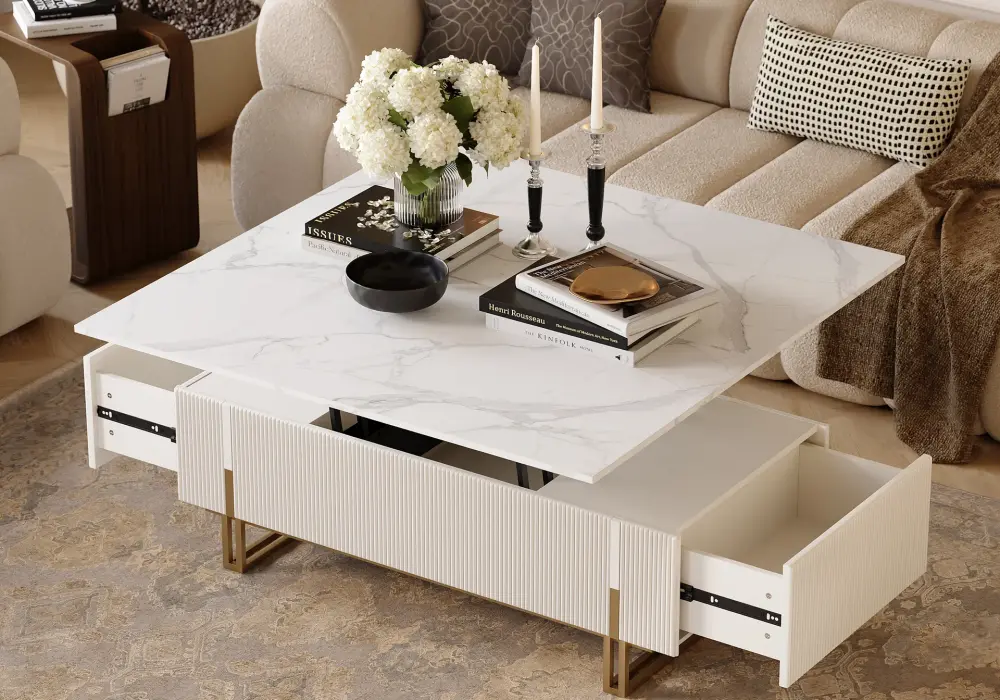
Where it fits best: an 84- or 90-inch sofa. At 47 inches it lands at 56% of an 84-inch sofa and 52% of a 90-inch one, right inside the balanced range. The 24-inch depth fills the standard depth range to the top, giving a generous surface.
How to use the two heights:
- Closed, 17 inches: an everyday coffee table, level with a typical seat.
- Raised, 24 inches: a work or dining surface for a laptop, a tray meal, or a game night, without leaving the sofa.
- Drawers and internal storage: a home for remotes, throws, and chargers, so the top stays clear.
Place it with the raised top and drawer fronts in mind. Leave the drawers an unobstructed approach, check the assembly drawing for how far the top travels when lifted, and follow the loading instructions for each position.
Round table: best for conversation seating
The Aura Smoked Brown Round Coffee Table with Sintered Stone Top measures 28 inches wide, 28 inches deep, and 18 inches high. The selected finish pairs a smoked brown base with a matte travertine-patterned sintered stone surface.
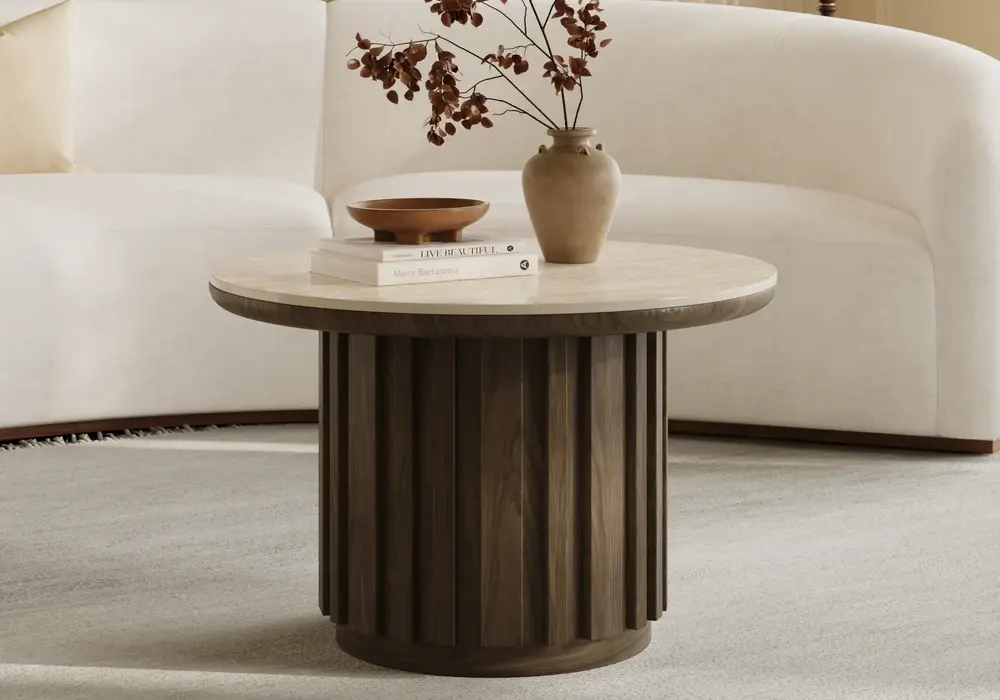
Where it fits best: a seating group where people sit on different sides, such as a sofa plus two armchairs, or the corner of a sectional. A round top gives every seat the same distance to reach, and with no corners it is easy to walk around.
Reading the numbers: a 28-inch circle is deeper than a 24-inch rectangle, so compare it with a rectangle's depth rather than its length. At 18 inches high it sits at the top of the standard range, which works well beside upright seats and standard-height sofas.
To test the fit, cut a 28-inch paper circle and place it on the floor. If you can get the base drawing, mark the base position too, since a pedestal affects where feet go.
Irregular top: best for a low, wide lounge layout
The 51-inch Sintered Stone Hidden Storage Coffee Table has a black, abstract cloud-shaped top and overall dimensions of 51 inches wide, 28 inches deep, and 14 inches high. It includes one drawer and one shelf.
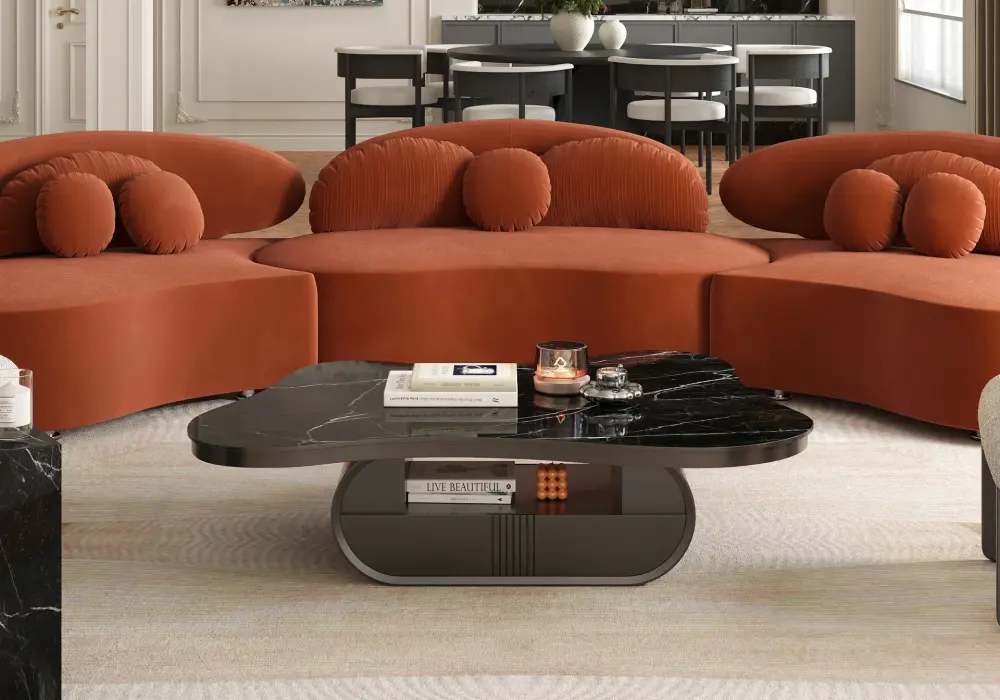
Where it fits best: an 84- to 96-inch sofa, where 51 inches covers 53–61% of the sofa width, and a low-profile seat of about 16–18 inches. The 14-inch height is the lowest of the three examples, which gives a relaxed, open lounge look. The 28-inch depth provides a large display surface for books, a tray, or a plant.
Reading the numbers: draw a 51-by-28-inch rectangle first, then refine the outline with the product drawing. The curves create comfortable pockets near individual seats, and the widest lobes define the space you need.
Storage: the drawer handles small items and the open shelf keeps magazines or a basket within reach. Plan the drawer's opening direction into your floor template.
Build a complete floor-space calculation
Add the sofa gap, table depth, and the space remaining beyond the table. For an 80-inch gap between a sofa and an opposite cabinet, a 16-inch sofa gap plus a 28-inch table leaves 36 inches beyond it. A 24-inch-deep table leaves 40 inches. Both give a comfortable walkway, so the choice comes down to the surface depth you prefer.
Tape the outline on the floor and live with it for an evening. Sit down, stand up, open nearby storage, and use any reclining seats. Include the rug and cords. When the layout works through a routine evening, you can choose the finish with confidence.
Frequently Asked Questions
What is the standard coffee table height?
16–18 inches is the standard range. Choose the lower end for low lounge seating and the upper end for upright sofas or tables that also serve as a work surface.
How long should a coffee table be for an 84-inch sofa?
Between 42 and 56 inches. A 44–48-inch rectangle is a reliable starting point, and the 47-inch Grovyn lift-top and 51-inch cloud table both sit in this range.
Does a round table need less clearance?
A round table gives you smooth, corner-free movement around it. Measure the full diameter, keep the same walking space you would for any table, and test with a full-size template.
Should I measure a lift-top coffee table while open?
Yes. Record the closed height, raised height, how far the top travels, and the drawer access. These numbers tell you exactly where the table can sit in front of your sofa.
Are the dimensions in a product title enough?
Use the title to shortlist, then confirm with the full specification: length, depth, and height of the selected variant. For irregular designs and sets, check whether the numbers describe one piece or the full arrangement.