

A TV stand in a small room has several jobs at once. It holds the screen at a comfortable height, keeps the remotes, cables and controllers out of sight, and often serves as the only storage piece on that wall. Because every inch counts, the right choice depends less on style and more on a few practical numbers: wall width, depth, TV size, screen height and what you actually need to store.
This guide walks through those numbers first, then looks at three TV stands that suit different small-space layouts: a long feature wall, a layout that may change, and a compact corner.
Table of Contents
What "small space" means when you are choosing furniture
"Small space" can describe very different rooms. A studio apartment may have a long, clear wall but little floor depth. A narrow living room may have the opposite problem. A bedroom may have a short wall but plenty of depth. Before looking at products, identify which dimension is your limit.
Width. Measure the clear wall between corners, door trim, windows, radiators and curtains. If part of the wall is a walking route into another room, leave it out of the measurement.
Depth. Measure from the wall to the front of the sofa or the main walkway. Many designers aim for about 30 to 36 inches of clear walking space on a main route, so a cabinet's depth directly affects how open the room feels. Stands in the 15 to 19 inch range are common in small living rooms because they hold equipment without taking much floor space. Remember that plugs and cables sit behind the cabinet, so allow a little extra room between the back panel and the wall.
Opening space. Drawers need room in front of them, and cabinet doors need room to swing. Picture where you will stand when you open them, and keep that spot free.
A simple trick is to outline the cabinet on the floor with painter's tape. Standing in the room and seeing the real footprint is more reliable than a number on a page.
Match the stand to the TV
A common guideline is that the stand should be at least as wide as the TV, and a little wider looks more balanced. TV sizes are quoted as a diagonal, but the cabinet has to match the width. For a standard 16:9 screen, the width is about 87 percent of the diagonal, and the height is about 49 percent.
TV size (diagonal) | Approx. screen width | Approx. screen height |
32" | 28" | 16" |
43" | 37.5" | 21" |
50" | 43.5" | 24.5" |
55" | 48" | 27" |
65" | 56.5" | 32" |
75" | 65.5" | 37" |
These are screen dimensions. Feet or a pedestal base can be wider than the screen on some models, so check your TV's manual for the base width before choosing a cabinet. If you plan to wall-mount, the TV can be wider than the cabinet below it, which gives you more freedom in a small room.
Plan the storage before you buy the cabinet
Sort what you want to store into three groups:
- Powered equipment: streaming box, game console, receiver, router.
- Daily items: remotes, controllers, headsets, chargers, cables.
- Occasional items: board games, books, blankets, dinnerware, albums.
Each group belongs in a different kind of space.
Drawers suit small, loose items that you reach for often. They keep remotes and cables from sliding around and make it easy to find things without moving anything on top.
Closed cabinets with shelves suit taller or bulkier items. Adjustable shelves help because the height of games, books or boxed items varies.
Ventilation. Powered equipment produces heat. Check each device's manual for how much space it needs, and give consoles and receivers open space around them rather than packing them into a closed drawer.
Remote signals. Many remotes use infrared, which needs a clear line to the device and does not pass through a closed door. Bluetooth or RF remotes, and IR extenders, work through solid fronts. If you want equipment inside a closed cabinet, check which type your devices use.
Cables. A power strip with surge protection, a few cable ties or clips, and labels on each plug make a media wall easier to live with. If your stand has a cable opening, thread the cords through it before you push the stand against the wall, which saves a lot of awkward reaching later.
Option 1: The 80-inch Sintered Stone Top LED Hidden Storage TV Stand
A single long cabinet can replace several smaller pieces, which is a useful strategy in an open-plan home. The 80-inch Sintered Stone Top LED Hidden Storage TV Stand measures 80 inches wide, 18 inches deep and 22 inches high. At 22 inches tall, it places a 55 to 65 inch TV close to a comfortable viewing height for sofa seating.
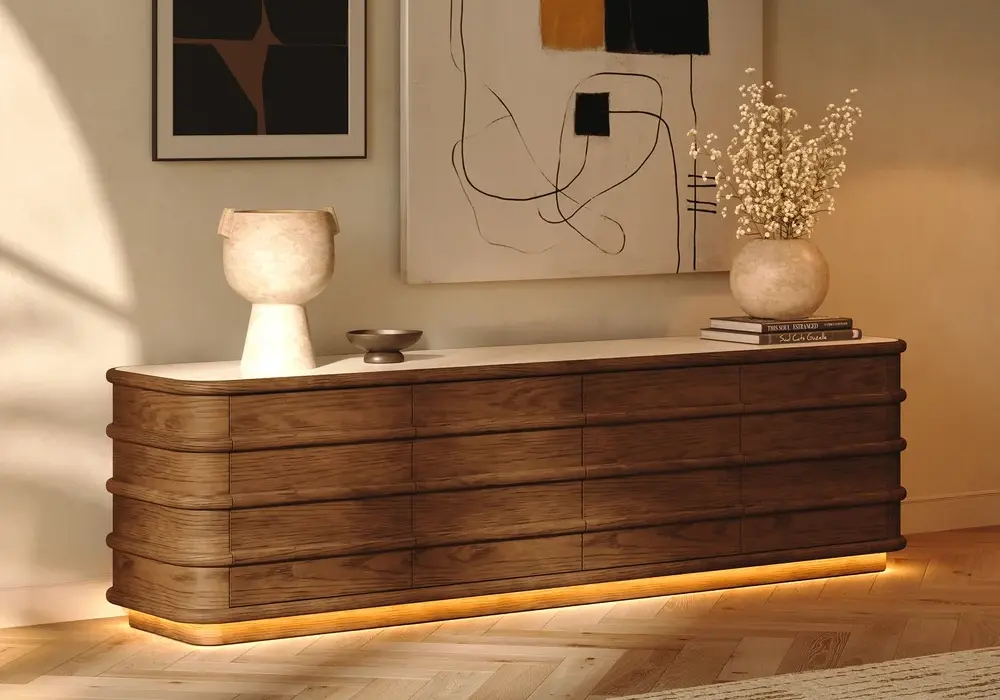
Its listed features include hidden storage with drawers, cable management, adjustable interior shelving, a sintered stone top and integrated LED lighting. Combined with its 80-inch width, those features make it a good fit for a room with one clear wall.
How it can be used:
- Open-plan apartment. The cabinet can act as a media wall and visually mark the living area, while the interior shelves hold items you would otherwise keep in a separate sideboard.
- Family living room. Assign sections by task: media equipment on the adjustable shelves, controllers and chargers in the drawers, and household items in whatever space remains.
- Wall-mounted TV setup. With the TV on the wall and a soundbar below it, the cabinet's long, low line keeps the wall looking tidy, and the LED lighting adds a soft glow for evening viewing.
Option 2: The Fero 47 to 71-inch Extendable TV Stand with 3 Drawers
A stand that changes width suits renters and anyone who rearranges furniture. The Fero Walnut Extendable TV Stand expands from 47 to 71 inches, is 16 inches deep and 16 inches high, and has three drawers on soft-close runners. The wood is FSC-certified.
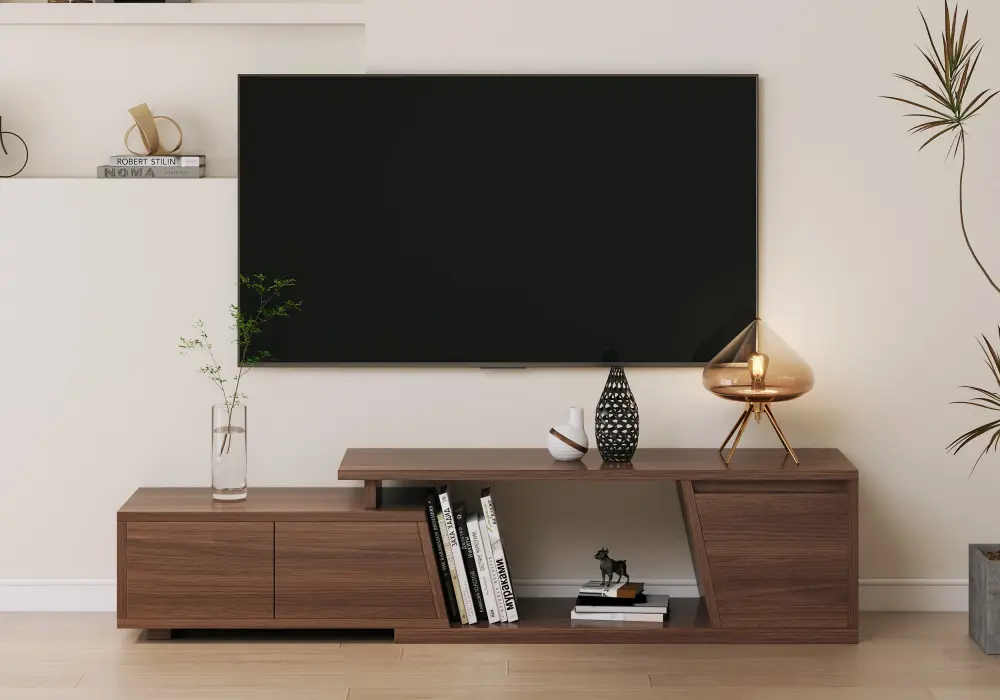
At 47 inches, the stand is a good match for a 50-inch TV (about 43.5 inches wide) or for a larger wall-mounted screen above it. Extended toward 71 inches, it has room for a 65-inch TV (about 56.5 inches wide) with space left for a soundbar or a few decorative objects. Its 16-inch depth leaves extra floor space in rooms where the sofa sits close to the screen.
How it can be used:
- Studio or one-bedroom apartment. Set it near 47 inches under a wall-mounted TV and use the three drawers for remotes, cables, chargers and streaming accessories.
- A rental you may leave. Because the width adjusts, the same stand can fit your next living room without needing a replacement.
- Bedroom. The low 16-inch height keeps the TV at a relaxed level when viewing from bed, and the quiet drawers are convenient at night.
Option 3: The 31-inch Ash Wood Veneer TV Stand with Wood Doors
For a corner or a narrow wall, a compact cabinet is often the best fit. The 31-inch Ash Wood Veneer TV Stand with Wood Doors is named for its approximate width, and its listed overall dimensions are 32 inches wide, 19 inches deep and 32 inches high. Use the 32-inch figure when you measure your space.
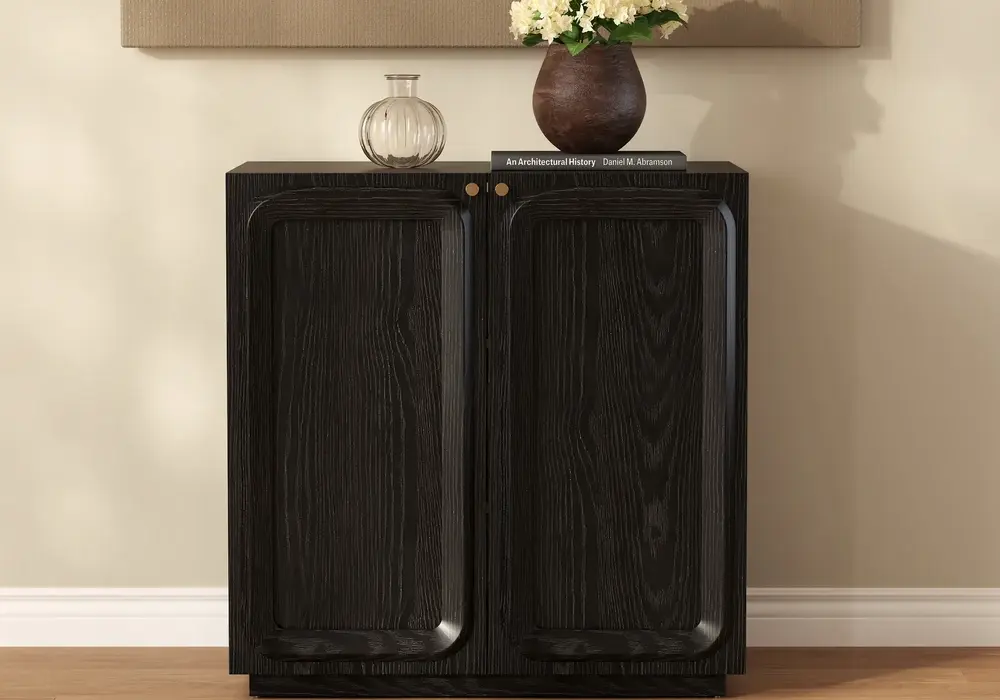
It has a spacious interior with adjustable shelves, a wide tabletop and an ash veneer finish over engineered wood. The listed weight capacity is 55.1 pounds, which is well above the weight of many TVs in the 32-inch class.
With a 32-inch height, the cabinet puts a compact TV close to eye level. A 32-inch TV (about 28 inches wide and 16 inches tall) on this cabinet has its screen center at about 43 inches, which suits upright seating such as a desk chair or dining chair. For sofa viewing, a smaller screen works best, or the cabinet can sit beside a wall-mounted TV as a storage piece.
How it can be used:
- Small living room or den. A compact TV on top, with books, games and blankets inside, makes one piece do the work of two.
- Beside a wall-mounted TV. The wide tabletop gives you a surface for a lamp, a plant or framed photos, and the doors hide dinnerware or household items.
- Home office or studio. A small screen on top and supplies behind the doors keep a multi-purpose room organized.
Set up the wall so it stays organized
Anchor furniture and TVs. The US Consumer Product Safety Commission's Anchor It! campaign recommends using TV-specific furniture and securing TVs and furniture according to the manufacturer's instructions. Do this when you first set up the room, while cables and shelves are still easy to reach.
Keep the top simple. A TV, one lamp or plant and a single framed photo usually look better than a full surface. Leave a little empty space so the cabinet reads as part of the room.
Repeat a material. An ash or walnut tone echoed in a chair leg, picture frame or rug connects the stand to the rest of the room.
Review the contents once a year. Storage fills up quickly. A short seasonal sort keeps the cabinet useful and stops it from becoming overstuffed.
Frequently Asked Questions
What size TV stand is best for a small living room?
Start with the clear wall width and the TV's actual width. A compact 32-inch cabinet suits a corner or narrow wall, an extendable stand from 47 inches fits many small walls, and an 80-inch console works well on a long, clear wall.
Is a shallow TV stand better for small spaces?
A shallower stand leaves more floor space for walking, especially when the sofa is close to the screen. Depths between 15 and 19 inches are common and still allow useful storage.
How high should a TV stand be?
Aim for the center of the screen to sit near seated eye level, about 40 inches for many people. Add the stand height, the TV's base height and half the screen height to estimate it.
Can an extendable TV stand replace a compact cabinet?
It can, if the room fits its shortest setting. An extendable stand such as the Fero starts at 47 inches and grows to 71 inches, which makes it flexible if you move or rearrange the room.
Should I choose drawers or doors for TV stand storage?
Drawers work well for small, frequently used items such as remotes and chargers. Doors and shelves suit taller or bulkier items. Many small homes use both: drawers for media accessories and a closed cabinet for household items.
Can I put a game console or receiver in a closed cabinet?
Check the device manual for ventilation requirements and give heat-producing equipment open space around it. Also confirm whether the remote uses infrared, which does not pass through a closed door, or Bluetooth or RF, which does.