

Short answer: pick a round table for a square nook, and a narrow rectangle or oval for a long, narrow room. If you host guests only now and then, add an extendable top so the table stays compact all week.
That's the whole decision in two lines. The rest of this guide helps you confirm it for your room: how to measure, how much space each shape really needs, and which dining tables are worth a look.
Table of Contents
Quick Size Guide: Table Shape, Seating and Room Size for Small Spaces
Use this chart as your starting point. The room figures assume about 36 inches of clearance from the table edge to the nearest wall or furniture on every side, which is enough to pull out a chair and stand up comfortably.
Table shape | Typical size | Comfortably seats | Minimum clear area needed |
Round | 36" diameter | 2–3 | about 9 × 9 ft |
Round | 42" diameter | 4 | about 9.5 × 9.5 ft |
Round | 48" diameter | 4–6 | about 10 × 10 ft |
Square | 36" | 2–4 | about 9 × 9 ft |
Rectangle | 48" × 30" | 4 | about 10 × 8.5 ft |
Rectangle | 60" × 36" | 4–6 | about 11 × 9 ft |
Oval | 60" × 30" | 4–6 | about 11 × 8.5 ft |
Where the main walkway runs behind a chair, add another 6–12 inches on that side.
Measure the Whole Dining Zone, Not Just the Tabletop
Start by marking the real boundaries of your dining area. A sideboard, radiator, sofa back or door swing often limits the space more than the walls do.
Then measure the table and chairs together. A chair that tucks fully under the table still sticks out into the room once someone sits down or stands up, and arms, padding and back angle all add to that.
The fastest check is a paper or tape template. Lay out the tabletop at full size with the chair outlines around it, then walk your normal route while someone sits at the "table". That five-minute test settles most shape debates.
Round Dining Tables: Best for Square Nooks
A round table is the strongest pick for a small, square dining corner or a spot you approach from several sides. There are no corners to bump into, everyone faces each other, and a pedestal base removes the corner-leg conflicts of a four-legged table.
Compare the diameter with your room's shorter side, because a round top needs width in every direction. Also look under the table: a wide pedestal foot can stop chairs from tucking in or crowd knees.
Skip round if the table has to sit flush against a wall every day. The curve leaves an awkward gap, and a square or rectangle works better there.
Oval Dining Tables: Best for Narrow Rooms With Busy Ends
An oval gives you the length of a rectangle with softer ends, which makes it a smart choice when people walk past the short sides of the table.
The Fluve 63–79-inch oval extendable dining table is a good example.
Why it suits a small space: it measures 63 inches when closed and extends to 79 inches with the butterfly leaf, so you can keep the compact size for everyday meals and only open it up for guests. At just 28 inches deep, it leaves plenty of walkway in a long room, and the leaf stores inside the table, so there's no loose leaf to find a closet for. It seats up to six when fully extended.
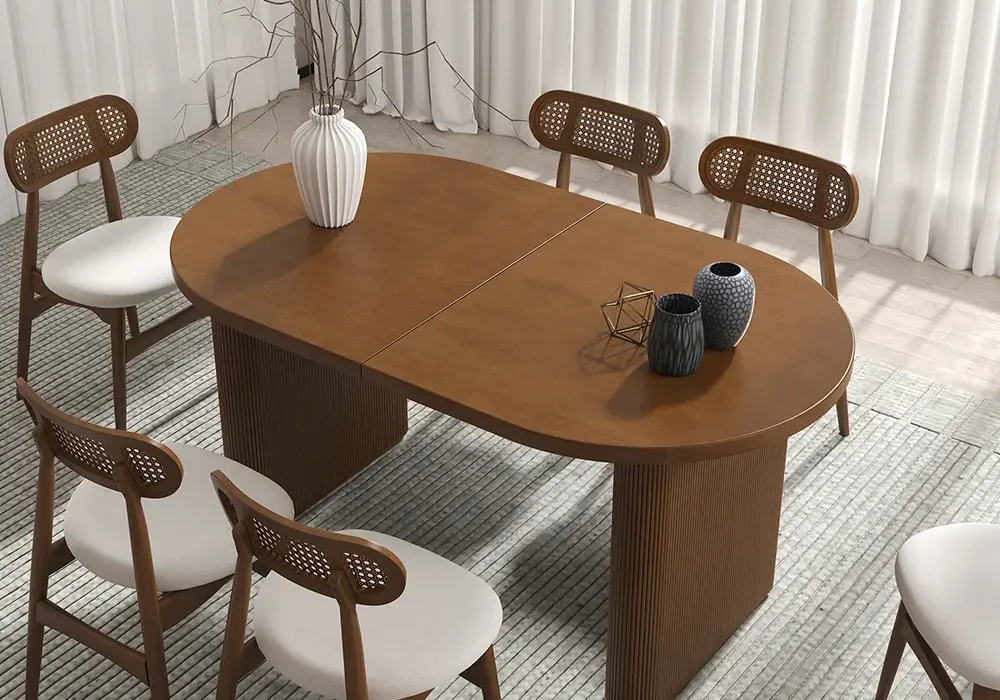
Keep in mind that rounded ends give you less full-width place-setting room than a rectangle of the same length, so trace your plates and serving dishes on the template before counting seats.
Rectangular Dining Tables: Best for Long, Narrow Spaces
A rectangle lines up naturally with a long room, a wall or a built-in bench. A slim top keeps a clear lane beside it while the length does the seating work, and the straight edges make place settings easy to arrange.
The 55–87-inch black extendable dining table is a strong fit here.
Why it suits a small space: it stays at a compact 55 inches for everyday meals and extends to 87 inches with its two removable leaves, seating up to eight when guests come. You only give up the extra floor space on the days you actually need it, and its 32-inch depth is easy to work with in a slim dining zone. Plan a spot for the leaves while they're off the table.
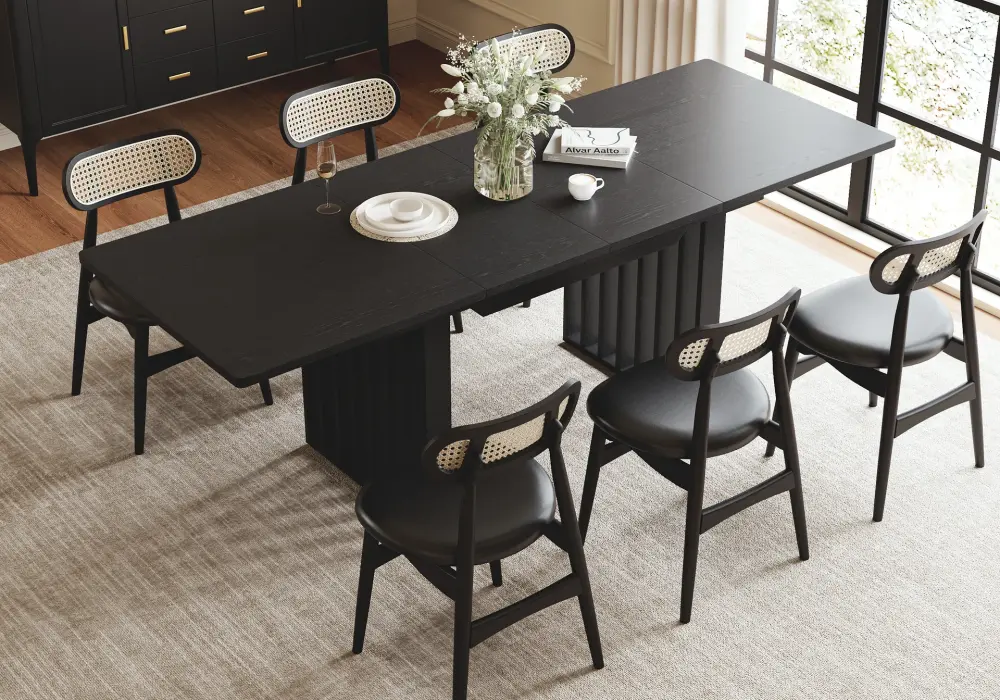
If the table sits near a wall, make sure the displaced furniture has somewhere to go when you extend it, and never rely on blocking a door or the main route.
Square Dining Tables: Best for Two to Four People
A square table works well for a couple or a compact group of four in a balanced room. It's easier to push toward a wall than a circle and gives the space a clear, tidy focal point.
The trade-off is growth. A bigger square gets wider in both directions, so it stops working quickly in a small room. If you often need extra seats, choose a rectangle or an extendable top instead.
If the table doubles as a desk, a compact square holds a laptop and one meal nicely, but not a permanent monitor and paperwork.
Convertible Dining Tables: Dining and Storage in One
When your dining area shares a room with the living space, a table that does double duty can free up floor you'd otherwise lose to a separate sideboard.
The extendable dining table with integrated storage sideboard is one option.
Why it suits a small space: it combines a dining table and storage cabinet in a single footprint and seats four to six, so you don't need to find room for a second piece of furniture for tableware.
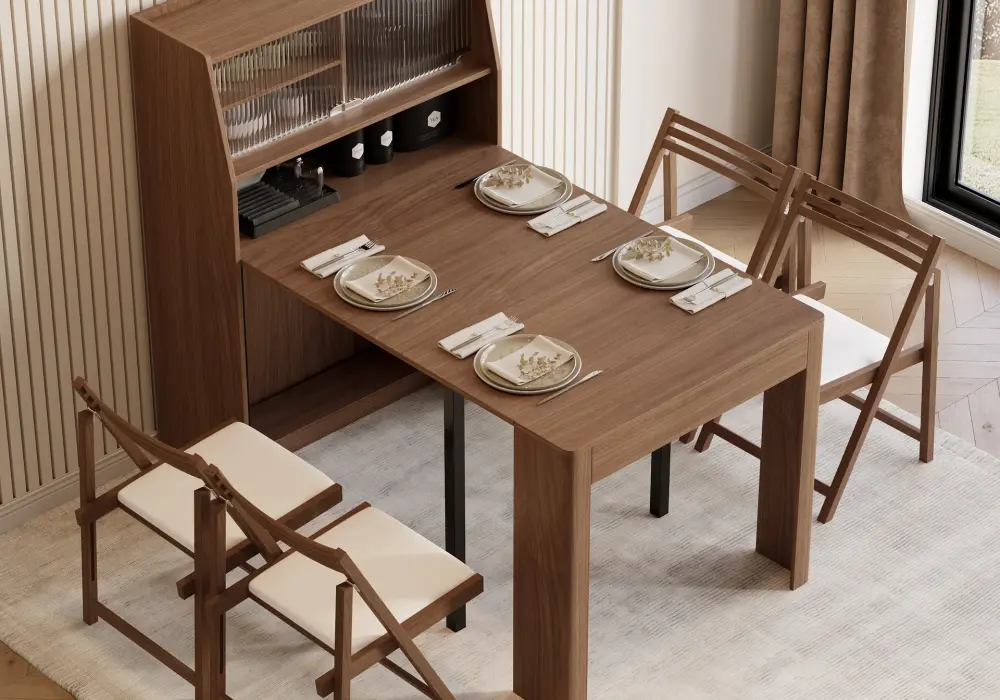
Before you buy, confirm the compact footprint, the table height and how the extension works. Opening the table daily gets old fast, but for weekend guests it's an easy trade for the floor space you gain the rest of the week.
Which Table Shape Fits Your Small Space?
Your small-space situation | Start with | Check this |
Compact square nook | Round or small square | Do occupied chairs fit on every side? |
Long, narrow dining zone | Narrow rectangle or oval | Is there a clear lane along the busiest edge? |
People walk past the table ends | Oval or round | Does the full width still leave clearance? |
Table sits against a wall | Rectangle or square | Which seats stay usable? |
Everyday meals plus occasional guests | Extendable rectangle or oval | Does the extended layout work in your room? |
Remember that a smaller rectangle can beat a larger round table in the same nook. Shape helps, but size matters more.
Final Checks Before You Order
- Chairs: compare seat width, depth and arm height, and make sure they slide under the table without hitting the apron or base.
- Tableware: trace your everyday plates, a serving bowl and glasses on the paper template. A narrow table works best when meals are plated in the kitchen.
- Extra chairs: keep spares somewhere else and bring them out for guests.
Choose the smallest table that serves your daily meals comfortably, then use an extendable top for the occasional crowd.
Frequently Asked Questions
What is the best dining table shape for a small space?
Round suits a square nook, and a narrow rectangle or oval suits a long room. Measure your room's shorter side first and pick the shape that leaves about 36 inches of chair clearance all around.
Is a round table better than a rectangular one in a small room?
Only in square or open spaces. In a narrow room, a slim rectangle leaves a clearer walkway than a round table of similar seating capacity.
Does an oval table save more space than a rectangle?
It makes the ends easier to walk around, but it offers less full-width setting room. Compare the real length and width of both before choosing.
Is an extendable dining table a good idea for a small apartment?
Yes, if the closed size works for everyday meals and you have a spot to store the leaves and spare chairs. It's the easiest way to get a small table for daily life and a large one for guests.
Can I use a bench to save room?
Yes. A bench along a wall tucks in neatly and seats more people than separate chairs, as long as there's enough clearance for someone to slide in and out.