

How big should a coffee table be? A useful starting point is to choose a table that is about two-thirds the length of your sofa, with roughly 16 to 18 inches (41 to 46 cm) of space between the sofa and the table. This proportion usually keeps the table connected to the seating without making the room feel crowded.
But there is no single standard coffee table size that works for every living room. The right dimensions depend on your sofa length, table width and height, seating arrangement, walkway clearance, and how you use the space. A sectional sofa, recliner, small living room, or lift-top table may require a different approach.
The easiest way to choose the right coffee table size is to start with your sofa, then check the space around it and test the table in its actual working position.
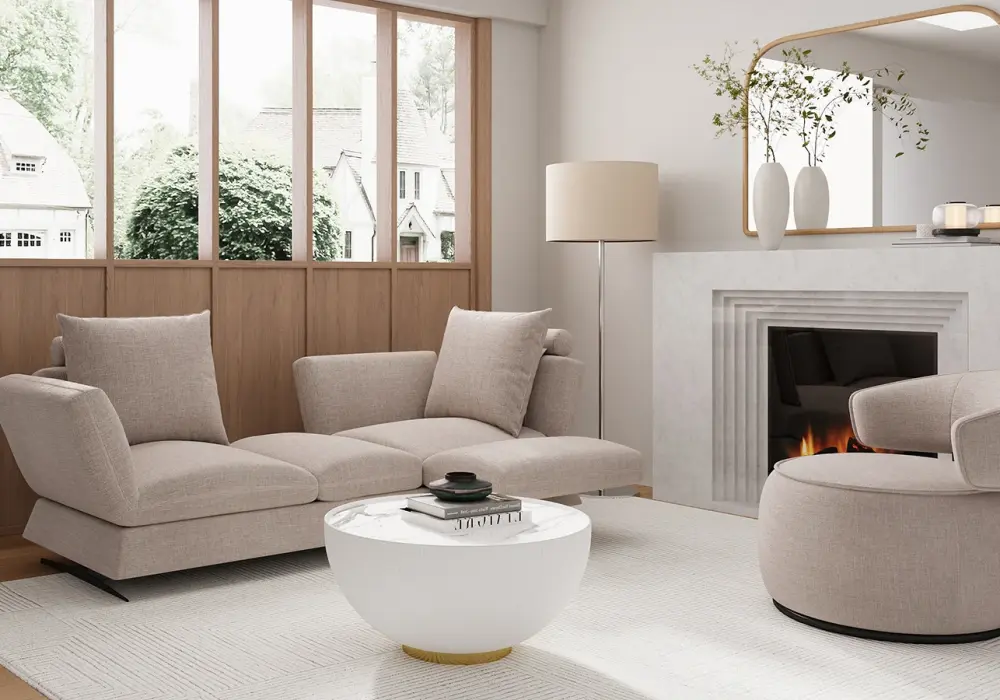
Beige Sintered Stone Leather Drum Coffee Table
Table of Contents
Start With Your Sofa Length
Your sofa is the most useful reference point when choosing a coffee table. The table should feel proportionate to the seating without taking over the room, but sofa length is only a starting point. The rest of the layout may require you to go smaller or choose a different shape.
Use the two-thirds rule as a starting point
Measure the section of the sofa that directly faces the coffee table. Multiply that length by about 0.67 to get a starting point for the table.
For example, an 84-inch (213 cm) sofa gives you a starting coffee table length of about 56 inches (142 cm).
Sofa Length | Starting Coffee Table Length |
60 in (152 cm) | About 40 in (102 cm) |
72 in (183 cm) | About 48 in (122 cm) |
84 in (213 cm) | About 56 in (142 cm) |
90 in (229 cm) | About 60 in (152 cm) |
96 in (244 cm) | About 64 in (163 cm) |
Treat these numbers as a proportion rather than a fixed rule. A slightly shorter coffee table may work better when a side chair shares the seating area, while a longer sofa may be better served by several smaller surfaces.
Measure the usable sofa length
A sofa's advertised width does not always tell you how much seating actually faces the table. Armrests, chaise sections, curved backs, and corner sections can change the usable span.
For a straight sofa, a rectangular coffee table often works well because its long edges serve several seats. With a chaise or sectional sofa, focus on the seats that need access to the table rather than simply matching the sofa's overall outside measurement.
Before shopping, measure the seating area that actually faces the table. This can prevent you from choosing a coffee table that looks proportionate on paper but feels too large once it is in the room.
Check Coffee Table Width and Clearance
The length of the table is only one part of its dimensions. Its width, the gap between the sofa and tabletop, and the space around the outside edge all affect whether the room feels comfortable or crowded.
Leave about 16 to 18 inches between the sofa and table
The sofa-to-coffee-table gap is an important part of the layout. Start with approximately 16 to 18 inches (41 to 46 cm) between the front edge of the sofa and the nearest edge of the coffee table.
This spacing usually provides enough room to sit comfortably, reach for drinks, and move your legs without making the table feel disconnected from the seating.
The ideal distance can vary with the furniture. A deep lounge sofa may need a little more space, while a compact sofa in a small living room may work better with a tighter arrangement.
Protect the main walking path
The space beyond the coffee table should be treated as a circulation route rather than leftover floor area.
A useful planning range is:
Traffic Area | Suggested Clearance |
Secondary passage | About 24 in (61 cm) |
Regular walkway | About 30–36 in (76–91 cm) |
Busy or frequently used route | Aim toward the wider end of the range |
These are general furniture-layout guidelines, not universal accessibility requirements. When a path needs to accommodate a wheelchair, walker, stroller, or other mobility equipment, plan around the actual needs of the people using the room.
For a small living room, this matters even more. A coffee table that fits the sofa proportionally may still be too large if it forces people to squeeze between the table, sofa, television, or doorway.
Measure the full footprint
A coffee table can have the right length and width and still be too large for the room.
Tape the proposed dimensions onto the floor before buying. Sit on the sofa, reach toward the center of the taped area, then walk around it using the routes people normally take. This quick test often reveals problems that a product photo cannot show.
The goal is not to fill the available floor space. It is to leave enough usable space for people to sit, reach, stand, and move naturally.
Choose the Right Coffee Table Shape
Once you have a rough size in mind, the shape can help you make better use of the available space. Rectangular, round, square, and nesting tables all interact differently with sofas, chairs, sectional seating, and walkways.
Rectangular coffee tables
A rectangular coffee table is a natural match for a straight sofa because it provides a long, central surface that several people can reach.
It also works well when the seating arrangement is relatively linear and the room has enough space for corners without disrupting circulation. For a longer sofa, a rectangular table can often provide better reach than a small round table with the same amount of floor space.
Round coffee tables
Round coffee tables can be useful in smaller rooms or layouts that include a sofa and accent chair. Without projecting corners, they can make the path around the table feel smoother.
However, a round coffee table is not automatically a better choice for a small living room. Its diameter still determines how much floor space it uses, and a very small round table may leave people at the ends of a long sofa reaching too far.
Square coffee tables
A square coffee table can suit a large sectional where seating surrounds the table from several directions. It can also create a symmetrical look in a square-shaped seating arrangement.
The trade-off is floor space. A square table can use more central floor area than a similarly sized round table, so check the clearance around all four sides.
Nesting coffee tables
Nesting tables are useful when you want flexibility rather than one large fixed surface. The pieces can stay compact when the room is quiet and spread out when more people need a place to set down drinks or snacks.
The key measurement is the maximum active footprint. The nested dimensions shown in a product photo may be much smaller than the amount of space the pieces need when fully separated.
The Homary Nesnesis nesting lift-top tables are one example of this approach. Their round shape and nesting function allow the arrangement to expand when needed, which can be useful when several seats need access to a surface. Measure the tables both nested and separated before deciding whether the set fits your room.

Choose a shape for a sectional sofa
For an L-shaped sectional, measure the seating that needs access to the coffee table on both sides rather than sizing the table from the sectional's total outside dimensions.
A round table can work well when people approach it from several directions, while a rectangular table can make better use of a long open side. The important checks are whether the table blocks the inside corner, restricts entry, or makes one part of the sectional difficult to reach.
The best coffee table for a sectional is the one that serves the seating without interrupting the main path through the room.
Consider Coffee Table Height and Everyday Use
Length and width determine the tabletop footprint, but height affects how comfortable the table feels once you sit down. The right coffee table height depends on your sofa seat height, seating posture, and whether the table is used for more than drinks and décor.
How high should a coffee table be?
A coffee table around the sofa seat height or slightly lower is a familiar starting point for casual lounging. However, the ideal height varies with the sofa's seat depth, cushion height, and the way you use the table.
Measure the actual sofa seat height from the floor and compare it with the table height in its normal position. Avoid assuming that every coffee table will work equally well with every sofa.
Match the height to how you use the table
A lounge-focused living room may benefit from a lower, easy-to-reach tabletop. A family room used for board games may need more usable surface. If the coffee table doubles as a laptop desk or casual dining table, a raised surface can be more practical.
This is where lift-top furniture needs a little extra planning. When the top rises, allow room for knees, hands, and the person using the raised surface. Drawers and extension panels can also require additional clearance.
Check moving parts before you buy
If a coffee table has a lift-top, drawers, or an extension mechanism, measure the table in its open position as well as its closed position.
For a lift-top design, test how far the top rises and where the user sits. For drawers, check which side they open toward and whether they interfere with a chair or walkway. For extendable designs, measure the maximum depth or width rather than relying on the advertised closed dimensions.
The practical rule is simple: size the table for how it works, not just how it looks when closed.
Use a Five-Minute Floor Template
Once you have a candidate coffee table size, a simple floor test can help you confirm whether the dimensions work in the real room. You do not need to move all your furniture or buy the table first.
Test the dimensions before you shop
Use painter's tape to mark the proposed table length and width on the floor. Leave the intended sofa-to-table gap, then sit in each commonly used seat and reach toward the center.
Walk around the taped area using the room's normal traffic route. Check the path to the television, doorway, kitchen, or other frequently used areas.
If the table nests, spread the pieces apart. If it lifts, raise the top. If it has drawers, open them. If you use a recliner, extend the footrest.
A piece of cardboard placed at the expected tabletop height can also help you judge the scale from a seated position.
Adjust one dimension at a time
If the test feels crowded, you do not necessarily need a completely different table.
Shorten the table if the sofa feels visually crowded. Narrow it if the sofa-to-table gap is comfortable but the walkway is tight. Choose separate smaller surfaces if one central table leaves the outer seats without easy access.
This approach is often more useful than choosing a coffee table from a standard size chart alone because it takes your actual room, furniture, and routines into account.
Coffee Table Size Cheat Sheet
These measurements provide a useful starting point when comparing coffee table dimensions. Use them together rather than treating any single number as a fixed rule.
What to Measure | Starting Point |
Coffee table length | About 2/3 of sofa length |
Sofa-to-table gap | About 16–18 in (41–46 cm) |
Secondary walkway | About 24 in (61 cm) |
Main walkway | About 30–36 in (76–91 cm) |
Table height | Around sofa seat height or slightly lower, depending on use |
The final size should be based on reach, comfort, circulation, and the way the furniture is actually used. This is especially important when choosing a coffee table for a sectional, small living room, or multifunctional space.
Frequently Asked Questions
What is the standard size of a coffee table?
There is no single standard coffee table size. Dimensions vary by sofa length, seating arrangement, room size, and table shape. A practical starting point is a table around two-thirds the length of the sofa, followed by a check of its width, height, and surrounding clearance.
How long should a coffee table be for an 84-inch sofa?
A two-thirds starting point gives an approximately 56-inch (142 cm) coffee table. You may want to go shorter if the room is compact or if an accent chair shares the seating area. Always check the walking space around the table before finalizing the size.
How wide should a coffee table be?
Coffee table width depends on the room, sofa depth, and walkway. Instead of choosing the widest table that fits your sofa proportionally, measure the available floor space and protect the main circulation route. A table with the right length can still feel oversized if it is too deep.
How far should a coffee table be from the couch?
Start with about 16 to 18 inches (41 to 46 cm) between the sofa and coffee table. Then test whether people can comfortably reach the tabletop, stand up, and use the seating without hitting their knees.
What coffee table size works for a sectional sofa?
For an L-shaped sectional, measure the seats along both sides that need access to the table. Round, rectangular, and nesting tables can all work, depending on the entry route and available floor space. Keep the inside corner and main walkway open.
Is a round coffee table better for a small living room?
A round table can be easier to walk around because it has no projecting corners, but its diameter still determines the amount of floor space it uses. Check reach from the sofa and make sure the table does not reduce the main walkway.
How do I measure a lift-top coffee table for my living room?
Measure the table in its closed position first, then measure the raised or extended position. Check the space needed for knees, hands, drawers, and any extension panels. The largest working footprint—not just the closed tabletop dimensions—should determine how much floor space you reserve.